
The peer-reviewed evidence does not support the claim that a detox shampoo reliably turns a positive hair drug test into a negative one.
The single most direct study on a marketed detox shampoo — Röhrich and colleagues, testing a drug test detox shampoo on hair from 14 autopsy cases with documented drug use — found that every drug originally present was still detectable after treatment.
Concentrations fell, but modestly: roughly 5% for cocaine, 9% for 6-MAM, 26% for morphine, and 36% for THC after single use. None of the samples dropped below the method’s detection limit.
That said, the honest answer is more complicated than “it’s all snake oil,” and the complications are what this article is about.
A separate and much larger body of research shows that aggressive chemical treatment of hair — bleaching, perming, relaxing, and prolonged exposure to solvents, detergents, and household products — can reduce measured drug concentrations substantially, sometimes by 50% to more than 90%. Those reductions are real, measurable, and reproduced across multiple independent laboratories.
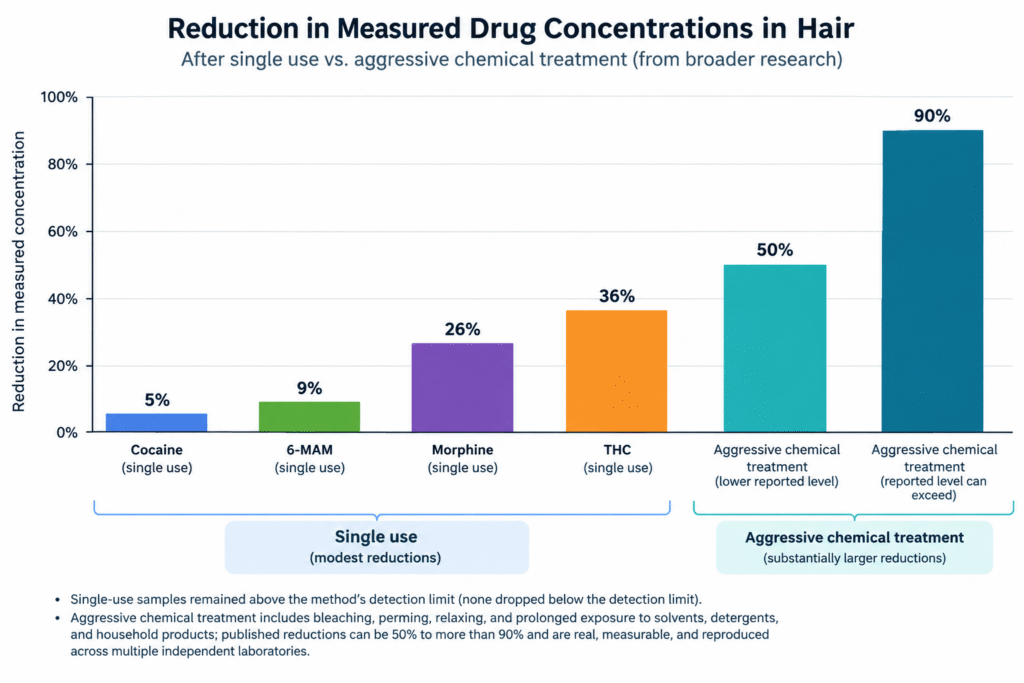
The gap between those two bodies of evidence is where nearly all of the confusion, marketing, and disappointment in this category lives.
What follows is a walk through how hair testing actually works, what the original studies found, what the popular products are and what evidence exists for each, and a detailed look at the Macujo method — the multi-step protocol most often built around these shampoos.
Summary
There is no published evidence that any marketed detox shampoo reliably produces a negative hair drug test. There is solid evidence that harsh chemical treatment lowers drug concentrations in hair — but lowering a concentration and clearing a cutoff are two different things.
How a Hair Drug Test Is Actually Conducted
Understanding why detox shampoos underperform requires understanding what the test measures and where in the hair it looks.
Why hair holds a record of drug use
Hair grows from a follicle several millimeters below the scalp surface, wrapped in a dense capillary bed. As the follicle builds new keratin, compounds circulating in the blood are incorporated into the developing hair shaft.
Three routes contribute:
- Blood to follicle — the primary route, and the one that produces the metabolites laboratories treat as evidence of ingestion.
- Sweat and sebum — drugs excreted onto the scalp can diffuse into the shaft after it emerges.
- External deposition — smoke, powder, or contact with a contaminated surface can leave drug residue on the outside of the hair.
Once keratinization completes, the hair shaft is a chemically stable, largely inert protein structure. Drug molecules are bound within it — associated with keratin, with melanin, and with internal lipid structures — not sitting loose on the surface waiting to be rinsed away.
This matters enormously for the detox shampoo question. A shampoo is applied to the outside of a fully formed, dead protein fiber. Whatever it accomplishes, it has to accomplish by penetrating the cuticle and mobilizing bound analyte out of the cortex.
Step by step: the collection
Hair collection is procedurally simpler than urine collection, and it offers far less room for a donor to influence the specimen.
- The donor presents photo identification, which is verified against the chain-of-custody form.
- The donor signs the chain-of-custody documentation.
- The collector inspects the head visually to confirm sufficient hair is available.
- A sample is cut from the back of the head near the crown, where growth rate is most consistent, as close to the scalp as possible.
- The sample is roughly the thickness of a pencil — approximately 90 to 120 strands, around 100 mg of hair.
- The collector preserves root-end orientation, because the root end represents the most recent growth.
- Standard testing uses the most recent 1.5 inches, corresponding to roughly a 90-day look-back at an average growth rate near 0.5 inch per month.
- The sample is sealed in foil or a specimen envelope with tamper-evident tape and labeled in the donor’s presence.
- Donor and collector both sign, and the sample ships under documented chain of custody.
Collection happens openly, in a normal room. There is no private stall, no temperature strip, and no specimen validity panel of the kind urine testing uses — because there is no fluid to dilute, substitute, or adulterate at the collection site.
Step by step: what the laboratory does
This is the part most product marketing skips, and it is the part that most directly undercuts the detox shampoo premise.
Stage 1 — The laboratory washes the hair itself. Before any analysis, the specimen is washed with solvents and detergents, and in most forensic protocols the wash solution is retained and analyzed separately. The purpose is to distinguish drug sitting on the outside of the hair from drug incorporated into the shaft from the bloodstream.
Stage 2 — Screening immunoassay. An ELISA-type assay screens the extracted or digested hair against target drug classes. It is fast and sensitive, but class-based and not conclusive on its own.
Stage 3 — Confirmation by mass spectrometry. Any presumptive positive goes to GC/MS (gas chromatography–mass spectrometry) or LC-MS/MS (liquid chromatography–tandem mass spectrometry). These methods identify the specific molecule by its mass signature and quantify it.
Stage 4 — Review and release. A certifying scientist, and in many employer programs a Medical Review Officer, reviews the report before it is released.
Two details from that sequence deserve emphasis.
First, the laboratory is already performing an aggressive wash. A detox shampoo is, in effect, attempting a cruder version of a step the lab performs anyway with validated solvents. Much of what the shampoo removes from the surface is material the lab’s own wash would have removed and excluded from the reported result regardless.
Second, confirmation targets metabolites, not just parent drug. For cannabis, the confirmation analyte is usually THC-COOH (11-nor-9-carboxy-THC), a metabolite the body produces internally. It is essentially absent from cannabis smoke and from external contamination, which is exactly why laboratories use it. It is also present in hair at extraordinarily low concentrations — and it got there from the inside.
Typical cutoff levels
Hair cutoffs are expressed in picograms per milligram of hair (pg/mg) — units roughly a thousand times smaller than the ng/mL figures used in urine testing.
| Drug class | Typical screening cutoff | Typical confirmation cutoff |
|---|---|---|
| Marijuana | 1 pg/mg (THC) | 0.05 pg/mg (THC-COOH) |
| Cocaine | 500 pg/mg | 500 pg/mg (with benzoylecgonine present) |
| Opiates (codeine, morphine) | 200 pg/mg | 200 pg/mg |
| 6-Acetylmorphine (heroin marker) | 200 pg/mg | 200 pg/mg |
| Amphetamine / methamphetamine | 500 pg/mg | 500 pg/mg |
| Phencyclidine (PCP) | 300 pg/mg | 300 pg/mg |
These are commonly published values for non-regulated workplace hair testing, and they vary by laboratory. Hair testing sits outside 49 CFR Part 40 and outside SAMHSA’s finalized Mandatory Guidelines. HHS proposed federal hair-testing guidelines in September 2020 but has not finalized them, partly over unresolved concerns about racial disparity in results. Confirm the applicable cutoffs with the specific program rather than assuming.
Situations that change the picture
- Insufficient head hair — body hair (chest, underarm, leg) can be substituted. Body hair grows more slowly and less predictably, giving a longer and less precise window, often estimated up to roughly 12 months. It also cannot be segmented into a timeline.
- A shaved head — this does not eliminate the test. It typically shifts collection to body hair, which usually means a longer look-back, not a shorter one.
- Chemically treated hair — bleached, permed, or relaxed hair may be noted by the laboratory as a limitation on the report rather than invalidating the test outright.
- Refusal — declining to provide a sample or to sign the chain-of-custody form is generally treated as equivalent to a positive under employer or court policy.
Summary
Hair testing measures drug and metabolite bound inside a dead keratin fiber, at picogram-per-milligram cutoffs, after the laboratory has already performed its own validated wash and analyzed that wash separately. That sequence is what any consumer product has to overcome.
What the Science Says About Removing Drugs From Hair
The research relevant to this question is scattered across forensic toxicology journals, and it was mostly conducted for a different reason than consumers assume. Laboratories study hair cleansing because they need to know how much washing removes external contamination without stripping incorporated drug — a false-positive problem and a false-negative problem at the same time.
The consumer question is a byproduct of that literature, not its purpose.
How to read this evidence
Four distinctions determine whether a given study means anything for a real person facing a real test:
- Spiked hair versus authentic hair. Drug soaked into drug-free hair in a beaker behaves very differently from drug incorporated through the bloodstream over months. Spiked hair gives up its drug far more easily. Studies using authentic user hair are the ones that matter.
- In vitro versus in vivo. Hair treated in a laboratory vessel for several hours is not the same as hair on a living scalp treated for 15 minutes.
- Percent reduction versus crossing a cutoff. A study reporting a 60% reduction has not reported a negative test. Those are different endpoints, and marketing in this category consistently conflates them.
- Which drug. Effects differ substantially between cannabinoids, cocaine, opiates, and amphetamines. A result for one does not transfer to another.
Finding 1: Ordinary and repeated washing has a small effect
Baeck and colleagues studied authentic methamphetamine-positive hair from 31 users. Washing the hair ten times with liquid soap reduced methamphetamine and amphetamine by 23.3% ± 4.5% — statistically significant (P < 0.01), but far from clearance.
A single dye treatment in the same study did somewhat more, at 32.6% ± 4.82%.
The practical reading: ten aggressive washes removed under a quarter of the drug. Ordinary hygiene washing in the weeks before a test is not going to meaningfully change a result.
Finding 2: Even laboratory decontamination has real limits
If purpose-built forensic protocols using laboratory-grade solvents cannot fully strip hair, consumer products are unlikely to.
Mantinieks and colleagues systematically optimized decontamination for externally contaminated cocaine and methamphetamine hair. The best single solvents were methanol and 0.1 M phosphate buffer at pH 6 — and even those removed only 28–38% of cocaine and 16–31% of methamphetamine in the solvent screen. Extending wash time beyond 30 to 60 minutes did not materially improve removal.
Blank and Kidwell reached a similar conclusion far earlier, finding that substantial cocaine remained in the final hair digest regardless of washing technique.
Aijala and colleagues used a 2⁴ factorial design to optimize decontamination across diazepam, heroin, cocaine, and THC, and found that the best protocol was analyte-specific — a different solvent, order, duration, and wash count for each drug — with at least four consecutive washes generally required. No single recipe worked well across all drug classes.
There is one notable counterexample pointing the other way. Duvivier and colleagues developed a methanol-then-SDS protocol with a final water rinse that removed all normal external THC contamination and more than 99% of unrealistically heavy contamination — while leaving incorporated THC in authentic user hair intact.
That finding is important and often overlooked in consumer discussions. A well-designed wash can separate surface contamination from incorporated drug almost completely. Which means external washing, done properly, removes the part of the signal that would not have counted against the donor anyway.
Finding 3: Harsh chemical treatment does substantially more
This is where reductions become large — and where the honest case for “something can be removed” actually lives.
Bleaching is the most consistently powerful manipulator in the literature. Pötsch and Skopp found that after in vitro bleaching of opiate-containing hair, only 2–18% of the starting amount remained. Perming left 20–30%.
Bleaching and dyeing in living people. Jurado and colleagues used paired treated and untreated hair from the same ten drug users — a strong real-world design. Cosmetic treatment lowered cocaine, opiates, cannabinoids, and nicotine, with most mean differences in the 40–60% range, and larger effects in more damaged hair. One heavily damaged bleached sample became entirely non-detectable for opiates and cannabis.
Relaxers and straighteners. Pritchett and Phinney treated certified reference materials and authentic user hair with commercially available “Lye” and “No-Lye” relaxers. In authentic drug-user hair, only 5–30% of the original concentration remained for cocaine, benzoylecgonine, and cocaethylene (P < 0.05).
Perming and dyeing across drug classes. Takayama and colleagues found permanent wave, dye, and decolorant treatments all reduced methamphetamine and amphetamine. Yegles and colleagues showed a 20-minute bleaching treatment reduced benzodiazepines. Van Elsué and Yegles showed in 30 THC-positive samples that bleaching and perming reduced all cannabinoids — with THC more affected than THC-COOH, CBN, or CBD — while a single permanent coloring had only a small effect.
That last detail is quietly significant for cannabis users: THC-COOH, the confirmation analyte, appears more resistant to chemical treatment than THC itself.
Dose dependence. He and coauthors reported that in methamphetamine-user hair, bleaching effects were dose-related, perming acted mainly by leaching drug out, temporary dyes had little effect, and permanent dye effects largely tracked hydrogen peroxide concentration.
Finding 4: The direct evidence on detox shampoos is thin
Peer-reviewed evidence on marketed detox shampoos against standard illicit-drug panels is remarkably sparse — a handful of studies of real relevance, none of them recent, and none testing the products promoted most heavily today.
Röhrich et al., 2000 — Ultra Clean. Hair from 14 autopsy cases with known drug histories was split and compared with and without a single product application. All drugs originally present remained detectable. Decreases were approximately 5% (cocaine), 9% (6-MAM), 26% (morphine), and 36% (THC). This remains the strongest direct test of a commercial detox shampoo against an illicit-drug panel, and it is now more than 25 years old.
Cirimele et al., 1999 — Cannabio shampoo. A hemp-containing shampoo was tested for whether it could create false positives. Under normal-use washing, THC, CBD, and CBN were never detected above the study limits. Only unrealistic prolonged incubation — drug-free hair soaked in a 20:1 water/shampoo mixture for up to five hours — produced CBD and CBN, and never THC.
Luginbühl et al., 2019 — four detox shampoos, alcohol markers. This study found substantial effects, but on a different analyte class. For EtG (ethyl glucuronide, an alcohol marker), one shampoo produced up to 86% reduction after 2.5 hours of incubation, and forensic proximal samples fell by 73% ± 12% after 8 hours. Notably, FAEE (fatty acid ethyl esters, the other alcohol marker) did not wash out — and in some shampoos increased, because the products themselves contained FAEE. Those exposure times bear no resemblance to normal use, and EtG results do not transfer to a cannabis or cocaine panel.
Bertges et al., 2022 — everyday products versus THC. This is the study most often cited by product marketers, and it rewards careful reading. Fifty-four authentic THC-positive hair samples were treated in vitro with vodka, Seborin hair tonic, Zydot shampoo, Desderman disinfectant, and Head & Shoulders shampoo. Mean THC reductions ranged from 52% (Zydot) to 65% (Desderman), with some individual reductions above 80%. Fourteen of 54 samples fell below 0.02 ng/mg, a threshold used in German forensic practice. The authors also reported that the manipulation was not visually detectable.
Mestria et al., 2024 — homemade regimens. The most concerning study for laboratories, and the closest published analogue to protocols like the Macujo method. Three “homemade” regimens discussed online — at least one built on baking soda and salicylic acid components — produced mean decreases of up to 90% for cocaine, 81% benzoylecgonine, 77% morphine, 89% 6-MAM, 37% methadone, 67% ketamine, 80% MDMA, 76% methamphetamine, and 60% THC — with little visible damage to the hair.
Read those last two studies closely and a pattern emerges that cuts both ways. Substantial reduction is achievable. But in Bertges, ordinary Head & Shoulders sat in the same broad range as the purpose-built detox shampoo, which says something uncomfortable about what a premium price is buying.
Comparative summary of the evidence
| Method | Representative studies | Typical reduction | What it means in practice |
|---|---|---|---|
| Ordinary repeated washing (10×) | Baeck 2011 | ~23% | Minimal; unlikely to change most results |
| Optimized laboratory solvent wash | Mantinieks 2019 | 16–38% (contamination) | Even validated protocols remove far from all |
| Single detox shampoo application | Röhrich 2000 | 5–36% | All drugs remained detectable |
| Marketed shampoo, in vitro, THC | Bertges 2022 | ~52% mean | Comparable to ordinary shampoo in the same study |
| Everyday products, in vitro, THC | Bertges 2022 | 52–65% mean | 14 of 54 samples crossed a low threshold |
| Detox shampoo, alcohol markers, prolonged | Luginbühl 2019 | up to 86% (EtG) | Requires 2.5–10 hours; EtG only; FAEE unaffected |
| “Homemade” multi-step regimens | Mestria 2024 | 37–90% by drug | Largest consumer-accessible effect documented |
| Single permanent coloring | Van Elsué 2019 | Small | Minor effect on cannabinoids |
| Perming / relaxing | Pötsch 1996; Pritchett 2015 | 70–95% | Only 5–30% remaining in authentic hair |
| Bleaching | Pötsch 1996; Jurado 1997 | 40–98% | Largest documented effect; visible hair damage |
The arithmetic nobody puts on the label
Here is the calculation that explains almost every conflicting testimonial you will read online.
A percent reduction only matters relative to where the concentration started.
Consider two people using the same product and achieving the same 60% reduction:
- Person A is a light, occasional user whose hair sits at 1.2 times the confirmation cutoff. A 60% reduction takes them to 0.48 times the cutoff. Negative result.
- Person B is a daily heavy user whose hair sits at 10 times the cutoff. The same 60% reduction takes them to 4 times the cutoff. Positive result.
Person B would need a reduction greater than 90% to clear — at the extreme upper end of what even bleaching achieves in the published literature.
That single piece of arithmetic accounts for the pattern visible across forums and product reviews: light and occasional users report passing at meaningfully higher rates, while heavy and chronic users report failing even after long, expensive, uncomfortable regimens.
It also explains why no product in this category can honestly promise an outcome. Neither the seller nor the buyer knows the starting concentration. Without that number, a stated percent reduction predicts nothing about a specific person’s result.
Summary
Across the literature, ordinary washing removes roughly 20% of incorporated drug, marketed detox shampoos somewhere between 5% and 52%, and harsh chemical treatment 40–95%. Whether any of that produces a negative test depends entirely on a starting concentration nobody involved can measure in advance.
The Popular Products: What They Are and What Evidence Supports Them
A note on how the products below are assessed. None of them has been the subject of an independent, peer-reviewed efficacy trial published in a forensic toxicology journal, with one partial exception noted below. In the absence of that, the assessment rests on three things: the plausibility of the stated mechanism against the published chemistry, the closest available published analogue, and the consistency of reported user outcomes.
Prices given are approximate and change frequently.
Old Style Aloe Toxin Rid (TestClear)
What it is. Sold exclusively through TestClear as a recreation of the original Nexxus Aloe Rid clarifying shampoo, a salon product reportedly discontinued in the early 2000s. The premise is that the original formulation contained a higher concentration of propylene glycol and chelating agents than the current Nexxus product, and that this older formulation is the one worth having.
Approximate price. $130–$235 for a 5 oz bottle; $170–$235 bundled with Zydot Ultra Clean. It is by a wide margin the most expensive product in the category.
Key ingredients and their plausible roles.
| Ingredient | Function |
|---|---|
| Propylene glycol | Humectant and penetration enhancer; can carry other agents past the cuticle |
| EDTA | Chelating agent; binds metal ions and mineral deposits |
| Sodium thiosulfate | Reducing agent; neutralizes chlorine and some reactive species |
| Cocamidopropyl betaine, sodium cocoyl isethionate, decyl glucoside | Surfactants; lift oils, sebum, and surface residue |
| Aloe vera, panthenol, sunflower seed oil | Conditioning agents to offset repeated clarifying washes |
| Citric acid | pH adjustment |
What the mechanism supports. The formulation is a genuine clarifying shampoo, and the surfactant plus penetration-enhancer combination is a chemically reasonable approach to mobilizing lipophilic compounds from the outer hair layers. Propylene glycol as a penetration enhancer is well established in dermatology. That makes the mechanism plausible rather than demonstrated.
What the evidence does not support. There is no published, independent study of this product. The nearest published analogue is Bertges 2022, where various shampoos and solvents produced mean THC reductions of 52–65% in vitro — and where an ordinary anti-dandruff shampoo performed comparably. The recommended regimen of 10 to 15 washes with 10 to 15 minute dwell times is directionally consistent with the finding that repeated exposure compounds removal, but 10 washes with ordinary soap produced only ~23% reduction in Baeck 2011.
Reported user outcomes. Reports skew positive among light and occasional users with 7 to 10 days of preparation, and notably worse among heavy and chronic users. Several users describe personal experiments suggesting partial removal in the 40–60% range. Failures despite full compliance are also reported consistently.
Practical cautions. Counterfeit product is a recurring problem on Amazon, eBay, Walmart Marketplace, and TikTok Shop. Deep discounts on a product with a $130+ floor price are a reasonable warning sign. Repeated clarifying washes cause scalp dryness, tightness, and flaking in some users.
Macujo Aloe Rid
What it is. A separate vendor selling an “old formula” Aloe Rid shampoo, marketed specifically as the shampoo component of the Macujo method described later in this article. The positioning is essentially identical to TestClear’s product: a recreation of the discontinued Nexxus formulation.
What to understand about the overlap. Two vendors sell what each describes as the authentic old-style Aloe Rid formulation. Neither has published a certificate of analysis comparing their product to the original Nexxus formula, and no independent laboratory comparison of the two has been published. A buyer cannot currently verify which, if either, matches the discontinued product.
Evidence. None specific to the product. The evidence position is identical to Old Style Aloe Toxin Rid: plausible mechanism, no published trial.
Practical note. The pairing of a proprietary shampoo with a multi-step protocol that also requires vinegar, salicylic acid face wash, and laundry detergent makes it structurally impossible for a user to attribute a pass or a fail to the shampoo itself. That is a marketing advantage for the seller and an information problem for the buyer.
Zydot Ultra Clean
What it is. A three-part single-use kit — shampoo, purifier, and conditioner — designed to be used on the day of the test rather than as a multi-day regimen. It is widely sold and comparatively inexpensive.
Approximate price. $30–$40 per kit.
Why this product is different from the rest of the category. Zydot Ultra Clean is the only marketed detox shampoo with meaningful peer-reviewed data attached to it, and that data appears in two studies.
Röhrich et al. (2000) tested a product marketed as Ultra Clean on hair from 14 autopsy cases. A single application left every drug still detectable, with reductions of roughly 5% (cocaine) to 36% (THC).
Bertges et al. (2022) included Zydot shampoo among five products tested in vitro against 54 authentic THC-positive hair samples. It produced a mean THC reduction of 52% — the lowest of the five products tested. Vodka, hair tonic, hospital hand disinfectant, and Head & Shoulders all performed at or above it, with Desderman disinfectant reaching 65%.
How to read that. This is the strongest evidence base in the category, and it is not favorable. A product performing at the bottom of a group that included ordinary anti-dandruff shampoo and vodka is difficult to justify on efficacy grounds — though it is also the cheapest of the branded options, which changes the value calculation somewhat.
Reported user outcomes. Commonly used as the test-day final step in combination protocols. Because it is almost never used alone, standalone outcome data barely exists.
High Voltage Detox Shampoo
What it is. A budget-priced detox shampoo from a brand better known for detox drinks, marketed for same-day use before a test.
Approximate price. $20–$40.
Evidence. None published. No independent testing, no peer-reviewed study, and no published analogue closer than the general shampoo findings in Bertges 2022.
Assessment. A single same-day application is the exact scenario Röhrich tested in 2000, and the exact scenario that left all drugs detectable. The published evidence for single-application detox shampoo use is the weakest evidence in the entire category. The low price limits the financial downside, but it does not improve the odds.
Other products in the category
Nexxus Aloe Rid (current formulation). The reformulated retail product, roughly $20–$60. It contains more conditioning agents — avocado oil, soybean oil, ceramides, wheat lipids, antioxidants — and, according to the “old formula” premise, less of the solvent content that would matter. If that premise is correct, this product is the wrong one. If the premise is wrong, the premium products are overpriced. Both possibilities cannot be true at once, and no published data resolves which it is.
Hair Razor Detox. Roughly $50–$70. No published evidence. Named specifically in user reports as having failed despite the protocol being followed.
Stinger Hair Folli-Kleen. Roughly $30–$50. No published evidence. Also named in user failure reports.
Head & Shoulders and other ordinary clarifying shampoos. Worth naming explicitly because Bertges 2022 tested Head & Shoulders directly and found a mean THC reduction in the same range as the branded detox product. This does not mean an ordinary shampoo will pass a test. It means the branded premium in this category is not currently supported by comparative data.
Side-by-side comparison
| Product | Approx. price | Intended use | Direct published evidence | Assessment |
|---|---|---|---|---|
| Old Style Aloe Toxin Rid | $130–$235 | 10–15 washes over 3–10 days | None | Plausible mechanism, unproven, highest cost, counterfeit risk |
| Macujo Aloe Rid | $130–$200+ | Component of Macujo method | None | Same position as above; formula unverifiable |
| Zydot Ultra Clean | $30–$40 | Single test-day kit | Röhrich 2000; Bertges 2022 | Best-studied, and the studies are unfavorable |
| High Voltage Detox | $20–$40 | Single same-day use | None | Weakest evidence scenario; low cost |
| Nexxus Aloe Rid (current) | $20–$60 | Clarifying shampoo | None | Marketed premise argues against its own use |
| Hair Razor Detox | $50–$70 | Multi-use | None | No evidence; documented user failures |
| Stinger Folli-Kleen | $30–$50 | Same-day | None | No evidence; documented user failures |
Regulatory status of the category
This context matters for judging any claim made on a label.
Products of this kind are sold as cosmetics. Cosmetics are not reviewed for efficacy before sale in the United States, and no federal agency evaluates whether a shampoo does what its marketing implies about drug test outcomes.
The Federal Trade Commission has authority over unsubstantiated advertising claims, and federal enforcement has periodically targeted marketers of products intended to defeat drug tests. Sellers in this category generally respond by keeping explicit outcome guarantees off the packaging while allowing testimonials and implication to carry the claim.
The practical consequence for a buyer: the absence of a regulator forcing evidence to exist is why, 25 years after the only direct study, there still is not a better one.
Summary
No product in this category has published, independent efficacy evidence. The one product with peer-reviewed data attached — Zydot Ultra Clean — performed at the bottom of a comparison group that included ordinary anti-dandruff shampoo. Price in this category does not track evidence.
The Macujo Method: A Detailed Review
The Macujo method is the most widely discussed pre-test hair protocol online, and it is the reason the shampoos above sell at the prices they do. It deserves a careful look, because it is meaningfully different from simply using a shampoo — and because its risks are meaningfully different too.
Where it came from
The method originated on drug-user forums in the 2000s, attributed to a poster using the name Mike Macujo, and spread through forum threads, YouTube, and Reddit rather than through any laboratory. It has since been commercialized, with vendors selling kits containing the components.
It has never been tested in a published study. Every efficacy claim attached to it traces back either to user testimonials or to inference from studies of other treatments.
The standard protocol
The commonly described sequence, repeated per wash cycle:
- Abstain from all drug use. The protocol cannot address hair that has not yet emerged from the scalp.
- Rinse the hair with warm water to open the cuticle.
- Apply distilled white vinegar (acetic acid) and work it thoroughly into the scalp and hair. Leave in place.
- Apply salicylic acid acne wash — Clean & Clear Pink, roughly 2–3% salicylic acid — over the vinegar without rinsing.
- Cover with a shower cap and wait 30 to 45 minutes. This is the step users describe as painful.
- Rinse thoroughly.
- Wash with Old Style Aloe Toxin Rid (or the vendor’s equivalent), working it in and leaving it for several minutes.
- Wash with liquid laundry detergent — Tide is the commonly named brand.
- Rinse completely.
- Repeat the full cycle — commonly 5 to 15 times over the days before the test, sometimes several times per day.
- On test day, finish with Zydot Ultra Clean — the three-step shampoo, purifier, and conditioner.
Users commonly apply petroleum jelly to the forehead, ears, and neck beforehand to limit chemical burns on skin.
What each step is supposed to do, and what the chemistry supports
| Step | Claimed purpose | What the chemistry and literature support |
|---|---|---|
| Warm water rinse | Swell and open the cuticle | Reasonable. Hydration does swell the cortex and increase permeability. |
| Vinegar (acetic acid) | Open the cuticle, strip buildup | Partially contradictory. Acids tend to smooth and close the cuticle; that is why acidic rinses are used cosmetically. Its role here is likely surface cleaning rather than cuticle opening. |
| Salicylic acid | Keratolytic; dissolve sebum and loosen keratin | The most defensible step. Salicylic acid is a genuine keratolytic and is lipid-soluble. Mestria 2024 identified salicylic acid as a component of at least one homemade regimen that achieved large reductions. |
| Aloe Rid shampoo | Penetrate and carry out mobilized drug | Plausible via propylene glycol and surfactants; unproven for this product. |
| Laundry detergent | Aggressive surfactant action | Chemically real. Laundry detergents contain harsher anionic surfactants and enzymes than personal-care shampoos. Also the step most likely to strip lipids and damage the cuticle. |
| Repetition | Compound the effect | Supported in principle. Aijala 2021 found at least four consecutive washes generally necessary; Baeck 2011 confirmed repeated washing compounds removal — though only to ~23%. |
| Zydot on test day | Final surface purification | The step with the most direct published evidence, and that evidence is unfavorable (Röhrich 2000; Bertges 2022). |
Several users who have documented their own protocols have independently noticed the sequencing problem in step 3 — that applying acid before the cleansing step may close the cuticle at the wrong moment. That critique is chemically coherent and has never been resolved, because the protocol has never been formally tested.
Does it work? An honest assessment
The evidence permits three conclusions and forbids a fourth.
Conclusion 1: The method is more aggressive than a shampoo alone, and aggression is the variable that correlates with removal in the literature. Every study showing large reductions involved something harsh — bleach, thioglycolate perm solution, relaxer, disinfectant, or a multi-component homemade regimen. The Macujo method is a multi-component harsh regimen. That places it in the right category.
Conclusion 2: The closest published analogue produced substantial reductions. Mestria et al. (2024) tested homemade regimens discussed online, including one built on baking soda and salicylic acid, and reported mean decreases up to 90% for cocaine and 60% for THC, with little visible hair damage. This is the strongest indirect support the method has — and it is genuinely meaningful support.
Conclusion 3: Substantial reduction still does not equal a negative test for many users. Return to the arithmetic. A 60% mean THC reduction clears a light user sitting near the cutoff and does nothing for a heavy user sitting at 10 times it. This is consistent with what user reports actually show.
What the evidence forbids: any claim of a predictable outcome. There is no published trial of this protocol. There is no dose-response curve, no success rate, no data on how many cycles are needed for a given starting concentration, and no way for a user to measure where they started. Anyone quoting a success percentage for the Macujo method is quoting something that was never measured.
The variables that decide the outcome
- Starting concentration — the dominant variable, driven by frequency and quantity of use. Not knowable in advance without an independent test.
- Which drug — cocaine appears more removable than THC-COOH in the treatment literature. Cannabis users face the harder analyte.
- Hair porosity and damage — Jurado found larger reductions in more damaged hair, and Schaffer found porosity rather than color drove uptake. Previously bleached or chemically treated hair is more permeable in both directions.
- Time available — the protocol depends on repetition, and repetition takes days. The most common situation described by people seeking this method is under 72 hours of notice, which is the worst case for it.
- Number of cycles completed — users frequently abandon the protocol partway due to scalp pain.
- Whether head or body hair is collected — the protocol addresses head hair. If the collector takes body hair, the preparation is largely irrelevant.
Safety risks worth taking seriously
These are documented consistently in user reports and are the predictable consequence of the chemistry involved.
- Chemical burns and contact dermatitis. A 30 to 45 minute occluded application of acetic acid plus salicylic acid under a shower cap is an aggressive dermatological exposure. Scalp burning, stinging, peeling, and rash are the most commonly reported effects.
- Salicylate absorption. Salicylic acid is absorbed through skin. Occlusion increases absorption. Repeated large-area occluded application, particularly in people with impaired kidney function or on salicylate-containing medication, carries a real if uncommon risk of systemic salicylate toxicity. Anyone with an aspirin sensitivity should treat this as a contraindication.
- Hair damage. Breakage, extreme dryness, and hair described as brittle or plastic-textured are commonly reported after repeated cycles.
- Eye and skin injury. Detergent and acid running into the eyes during rinsing is a foreseeable injury.
- Compounding with bleach. Some variants add bleaching, which multiplies both the removal effect and the risk of chemical burn and hair loss.
Anyone with eczema, psoriasis, scalp inflammation, open wounds on the scalp, or a known salicylate sensitivity should not attempt this protocol. Persistent burns, swelling, or systemic symptoms such as ringing in the ears, nausea, or confusion after salicylic acid exposure warrant prompt medical attention.
Cost
A full protocol built around a premium shampoo, Zydot, and consumables typically runs $200 to $350. Users who fail after that expenditure describe it as one of the more painful aspects of the experience, and it recurs constantly in product reviews.
Related protocols
The Jerry G method. Bleach and dye the hair, wait roughly ten days, bleach and dye again, then use Aloe Rid and Zydot. It leans directly on the strongest finding in the literature — bleaching produces the largest reductions — and accordingly carries the largest risk of visible hair damage and chemical injury. It also produces obviously chemically treated hair, which a laboratory may note on the report.
The “reverse Macujo.” Reorders the steps to place the acid after the cleansing agents, addressing the cuticle-closing critique above. Entirely untested.
Ad hoc variants. Baking soda, hair relaxer, and additional detergents appear in user-designed regimens. Mestria 2024 suggests these can be effective at reducing concentrations; they also escalate the injury risk without any protocol-level safety guidance.
Summary
The Macujo method is more aggressive than any single shampoo, and the closest published analogue — Mestria 2024 — found homemade regimens of this type can reduce drug concentrations by 37% to 90% depending on the substance. It has never itself been tested, offers no predictable success rate, costs $200–$350, and carries a genuine risk of chemical burns and hair damage. Whether the reduction it achieves is enough depends on a starting concentration the user cannot measure.
What the Evidence Says Actually Reduces Risk
Since the question behind the search is usually practical rather than academic, it is worth stating plainly what the literature supports.
Time and abstinence. This is the only approach with unambiguous support. Hair records exposure during the period it was growing. A standard 1.5-inch collection covers roughly 90 days at an average 0.5 inch per month. Hair that grew during a period of no use contains no drug from that period, and nothing needs to be removed from it.
Understanding the recent-use blind spot. Hair testing generally cannot detect use within roughly the last 5 to 7 days, because newly formed hair has not yet emerged past the scalp surface. This is a real characteristic of the test, not a loophole to engineer around.
Knowing that shaving does not help. A shaved head typically shifts collection to body hair, which carries a longer and less precise look-back — often estimated up to 12 months. It also cannot be segmented, which removes the ability to demonstrate a timeline of abstinence.
Testing independently first, where time allows. Independent hair analysis before the actual test is the only way to convert an unknown starting concentration into a known one. It costs money and takes time, and for anyone seriously considering a $200–$350 protocol, it is the more rational first expenditure.
Using the review process that exists. Where a Medical Review Officer or certifying scientist reviews results, legitimate prescriptions and documented contamination exposures can be raised at that stage. That channel is forfeited by people who do not respond.
Raising external contamination properly, when it genuinely applies. The laboratory wash analysis and the parent-drug-versus-metabolite distinction exist specifically to separate contamination from ingestion. A donor disputing a result can request the wash-analysis data and the metabolite results. Notably, the contamination literature is not settled: Blank and Kidwell, and later Romano and colleagues, found cocaine contamination can persist despite washing, and Schaffer and colleagues found that porosity, not hair color, drove uptake in experimentally contaminated hair.
Retesting the retained specimen. Many laboratories preserve a remaining portion. There is no standardized split-specimen process for hair as there is for DOT urine testing, so this has to be confirmed with the specific program.
Risks and Consequences Worth Weighing
Health. Covered above: chemical burns, dermatitis, salicylate absorption under occlusion, and hair damage are the realistic downsides of aggressive protocols.
Financial. $200 to $350 for an approach with no published success rate, purchased most often by people describing themselves as financially stretched, on short notice, and under acute stress. The counterfeit risk on secondary marketplaces adds a second way to lose the money.
Legal. This is the risk most often ignored, and it varies sharply by context.
A number of states have statutes criminalizing the manufacture, sale, distribution, or use of products intended to defraud a drug test. Penalties range from misdemeanor to felony depending on the jurisdiction and the conduct.
The stakes rise substantially where a test is court-ordered — probation, parole, drug court, or a custody proceeding. Attempting to manipulate a court-ordered test can be treated as a separate matter from the underlying test result, with consequences that may exceed those of a positive.
In an employment context, a positive result usually carries defined consequences and, in some programs, a defined path back. Conduct treated as evasion generally does not.
A note on the state of the law. Some states restrict hair testing for employment purposes, and disparate-impact challenges have been litigated on the theory that higher melanin content increases drug binding in hair — see Jones v. City of Boston (1st Cir. 2014). Where legal consequences are involved, an attorney familiar with the relevant state’s employment and testing law is the appropriate resource.
Frequently Asked Questions
Do hair detox shampoos work?
Not reliably, based on the published evidence. The only direct study of a marketed detox shampoo against an illicit-drug panel found all drugs still detectable after use. Reductions of 5% to roughly 52% have been measured for various shampoos, which may be enough for someone very close to a cutoff and is not enough for a regular user.
Can anything remove THC from hair completely?
Nothing in the published literature removes drug from hair completely. Bleaching produces the largest documented reductions, with only 2–18% of the original amount remaining in one opiate study, but even that is reduction rather than elimination — and it causes visible hair damage.
Will the laboratory know I used a detox shampoo?
There is no routine assay for detox shampoo residues, and hair panels test for drugs and metabolites rather than product ingredients. Bertges 2022 and Mestria 2024 both reported that the manipulations they tested were not visually detectable. A laboratory can, however, note obvious cosmetic treatment such as bleaching on the report.
Does the laboratory’s own wash step remove the drug?
It removes external contamination, which is its purpose. Duvivier’s validated methanol-then-SDS protocol removed all normal external THC contamination while leaving incorporated THC intact. Incorporated drug is what gets reported.
Is one wash on test day enough?
That is precisely the scenario Röhrich tested in 2000, and every drug remained detectable. Single-application use has the weakest evidence in the category.
Why do some people report passing?
Starting concentration is the likely explanation. A light or occasional user may sit close enough to the cutoff that a 40–60% reduction clears it, while a daily user at ten times the cutoff will not clear with the same reduction. Time since last use, hair growth in the interim, and the specific cutoff used all contribute.
Does bleaching my hair work better?
It produces larger reductions in the literature, yes. It also damages hair visibly, can be noted by the laboratory, carries a risk of chemical burn and hair loss, and still does not guarantee falling below a cutoff.
What if I shave my head?
Body hair is typically collected instead, with a longer and less precise detection window — often estimated up to roughly 12 months — and no ability to segment a timeline.
Do these products work for a court-ordered test?
The chemistry does not change, but the legal exposure does. Attempting to manipulate a court-ordered test can carry consequences separate from and potentially greater than the test result itself.
How long does THC stay in hair?
Hair does not clear the way blood or urine does. The drug stays in the hair segment that grew during use until that segment is cut off. A standard 1.5-inch collection covers roughly the last 90 days.
The Bottom Line
Detox shampoos occupy an unusual position: the underlying science is not entirely fictional, and the products are still not supported by evidence for the outcome they are bought for.
What the evidence supports: chemical treatment of hair reduces measurable drug concentrations, and more aggressive treatment reduces them more. Bleaching, perming, relaxing, and multi-component homemade regimens can produce reductions from 40% to more than 90%. Repeated exposure compounds the effect. None of this is fringe — it is a consistent finding across independent forensic laboratories over three decades.
What the evidence does not support: that any marketed detox shampoo reliably crosses the gap between reduction and a negative result. The one direct study left every drug detectable. The best-studied branded product performed at the bottom of a comparison group that included ordinary anti-dandruff shampoo. No product in this category has a published success rate, because no product in this category has been tested for one.
The single most useful thing to understand is that percent reduction is meaningless without a starting concentration. A 60% reduction is a pass for one person and a fail for another, and neither knows which they are. That is why the testimonials contradict each other so violently, and why no seller can honestly promise anything.
For anyone weighing this decision: time and abstinence remain the only approach the evidence supports without qualification, independent testing is the only way to replace guesswork with a number, and the review and challenge processes that exist within testing programs are forfeited by people who do not use them.
How This Article Was Researched
This article is based on primary, peer-reviewed forensic toxicology literature — original research papers rather than reviews, product pages, or secondary summaries. Where a study is cited, the reported effect sizes, sample sizes, and statistical results are taken from the original publication or its published abstract.
Evidence quality varies across the topics covered, and the article flags this where relevant. Studies using authentic drug-user hair are weighted more heavily than studies using spiked drug-free hair. In vivo and paired-sample designs are weighted more heavily than in vitro treatment. Several key studies are small, and some report effect sizes descriptively rather than with formal statistical testing.
Known limitations of the evidence base: peer-reviewed testing of marketed detox shampoos is sparse and dated; the strongest direct study is from 2000; much recent product-manipulation research addresses THC or alcohol biomarkers rather than full drug panels; and no published study exists for the Macujo method or for the individual branded shampoos reviewed here. Where evidence is absent, this article says so rather than substituting inference for data.
This article is provided for informational and educational purposes. It is not legal or medical advice, and it is not an endorsement of any product or method described. Testing procedures, cutoff levels, detection windows, laboratory practices, and legal consequences vary by test type, laboratory, employer policy, and jurisdiction. Attempting to alter the result of a drug test may violate state law and, where a test is court-ordered, may carry consequences separate from the test result. Chemical hair treatments carry a genuine risk of skin and hair injury. Consult a qualified physician about health concerns, and an attorney familiar with your jurisdiction about legal ones.
Sources
Detox shampoos and consumer products
- Röhrich J, et al. Effect of the shampoo Ultra Clean on drug concentrations in human hair. Int J Legal Med. 2000. doi:10.1007/PL00007707
- Cirimele V, et al. Cannabis and shampoo: hair analysis findings. J Anal Toxicol. 1999. doi:10.1093/jat/23.5.349
- Luginbühl M, et al. Detox shampoos for EtG and FAEE in hair — results from in vitro experiments. Drug Test Anal. 2019. doi:10.1002/dta.2570
- Bertges L, et al. Manipulation of THC-positive hair samples with everyday products. Metabolites. 2022. doi:10.3390/metabo12100900
- Mestria S, et al. Effects of homemade hair treatments on drug concentrations in hair. Drug Test Anal. 2024. doi:10.1002/dta.3541
Cosmetic and chemical treatment of hair
- Pötsch L, Skopp G. Stability of opiates in hair fibers after exposure to cosmetic treatment. Forensic Sci Int. 1996. doi:10.1016/S0379-0738(96)01974-3
- Jurado C, et al. Influence of the cosmetic treatment of hair on drug testing. Int J Legal Med. 1997. doi:10.1007/s004140050056
- Takayama N, et al. Effects of cosmetic treatment on methamphetamine and amphetamine in hair. Biomed Chromatogr. 1999. doi:10.1002/(SICI)1099-0801(199906)13:4<257::AID-BMC830>3.0.CO;2-V
- Yegles M, et al. Influence of bleaching on the stability of benzodiazepines in hair. Forensic Sci Int. 2000. doi:10.1016/S0379-0738(99)00152-8
- Baeck S, et al. Effects of repeated washing and dyeing on methamphetamine and amphetamine in hair. Forensic Sci Int. 2011. doi:10.1016/j.forsciint.2010.06.023
- Pritchett JS, Phinney KW. Influence of chemical straightening on the stability of drugs of abuse in hair. J Anal Toxicol. 2015. doi:10.1093/jat/bku106
Laboratory decontamination and external contamination
- Blank DL, Kidwell DA. External contamination of hair by cocaine: an issue in forensic interpretation. Forensic Sci Int. 1993. doi:10.1016/0379-0738(93)90268-F
- Thorspecken J, et al. In vitro contamination of hair by marijuana smoke. Clin Chem. 2004. doi:10.1373/clinchem.2003.026120
- Schaffer M, Hill V, Cairns T. Hair analysis for cocaine: the requirement for effective wash procedures and effects of drug concentration and hair porosity. J Anal Toxicol. 2005. doi:10.1093/jat/29.5.319
- Duvivier WF, et al. Evaluation of the thermal stability and decontamination of THC in hair. Forensic Sci Int. 2016. doi:10.1016/j.forsciint.2015.12.036
- Mantinieks D, et al. An improved hair decontamination procedure for cocaine and methamphetamine. Drug Test Anal. 2019. doi:10.1002/dta.2681
- Aijala A, et al. Optimization of hair decontamination using a design-of-experiments approach. J Anal Toxicol. 2021. doi:10.1093/jat/bkaa171
- Ramírez Fernández MM, et al. Effect of washing procedures on drug concentrations in hair. Drug Test Anal. 2022. doi:10.1002/dta.3237
Testing procedure, regulation, and legal context
- HHS/SAMHSA — Mandatory Guidelines for Federal Workplace Drug Testing Programs Using Hair (Notice of Proposed Rulemaking), Federal Register, Sept. 10, 2020
- SAMHSA — Hair External Contamination (Drug Testing Advisory Board presentation, 2013)
- Labcorp — Hair Follicle Drug Testing: Process and Benefits
- Psychemedics — Hair Drug Testing Facts and FAQs
- 49 CFR Part 40 — Procedures for Transportation Workplace Drug and Alcohol Testing Programs (eCFR)
- Jones v. City of Boston, 752 F.3d 38 (1st Cir. 2014) — Justia